
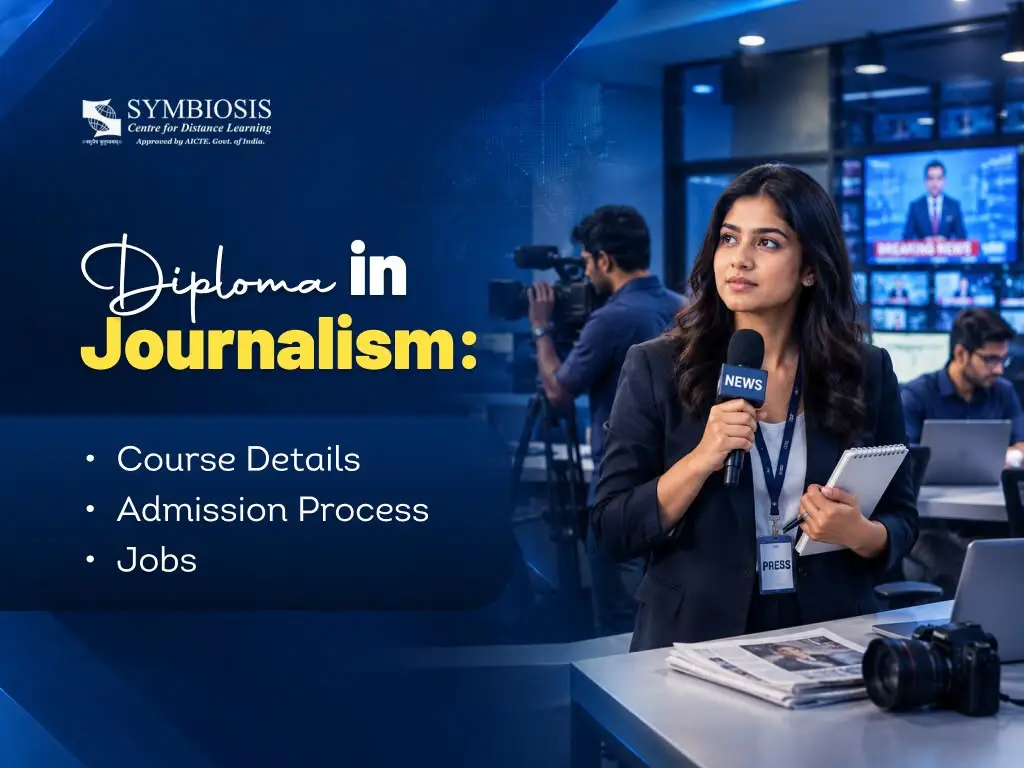

A Diploma in Journalism introduces learners to news reporting, writing, editing, and media communication. The course can help students understand how news is researched, verified, and presented across print, television, and digital platforms. Depending on the programme, learners may also study media ethics, corporate communication, and online journalism.
Eligibility, fees, and duration vary by institution. Some courses accept students after Class 12, while postgraduate diploma programmes generally require graduation.
Graduates looking to build knowledge in this area can explore SCDL’s Post Graduate Diploma in Journalism and Mass Communication. The one-year programme covers journalistic writing, print and television journalism, online journalism, media laws and ethics, and other areas of media communication.
Understanding the course structure, admission requirements, fees and career options can help you decide whether a journalism qualification aligns with your educational background and career goals.
What Is a Diploma in Journalism?
A Diploma course in journalism is a career-oriented qualification that introduces learners to the principles and practices of news reporting, writing, editing, and media communication. It helps them understand how to gather information, verify facts, present news clearly, and follow professional standards.
The subjects depend on the institution and level of the programme. A course focused on journalism may concentrate on reporting and news writing, while a journalism and mass communication programme can also cover advertising, public relations, corporate communication, and digital media.
Students may study topics such as:
- Journalistic writing: Writing news reports, headlines, and other forms of media content.
- Reporting and editing: Gathering information, checking facts, and preparing stories for publication.
- Print and broadcast journalism: Understanding how newspapers, television, and other broadcast formats deliver news.
- Digital journalism: Learning about online news platforms and digital content.
- Media laws and ethics: Understanding responsible reporting, privacy, accuracy, and legal considerations.
- Mass communication: Understanding how different media channels communicate information to their audiences.
A Diploma in Journalism may suit students who want to explore media as a career, graduates who want to add a specialised qualification, or working professionals who want to build their understanding of communication.
Who Can Consider a Diploma in Journalism?
A Diploma in Journalism may suit individuals who want to build a career in media, news reporting, or content creation. The course can be relevant to different learners depending on their educational background and career goals.
- Students after Class 12: Those interested in journalism and exploring entry-level diploma courses that accept their qualifications.
- Graduates from any stream: Those who want to develop skills in news writing, reporting, editing, and mass communication.
- Aspiring journalists: Those looking to understand how print, television and digital news platforms work.
- Working professionals: Those interested in strengthening their writing, research or communication skills for media-related roles.
- Content writers and communication professionals: Those who want to expand their knowledge of journalistic writing, media ethics and news production.
Diploma in Journalism Eligibility
The eligibility criteria for a Diploma in Journalism depend on the course level and the institution offering it. Some programmes accept students who have completed Class 12, while postgraduate diploma courses generally require a bachelor’s degree from a recognised university.
Before applying, check the following requirements:
- Educational qualification: Class 12 completion may be sufficient for an entry-level diploma, while a postgraduate diploma usually requires graduation.
- Minimum marks: Some institutions may specify a minimum percentage in the qualifying examination.
- Final-year students: Certain institutions allow students awaiting their final results to apply, subject to their admission rules.
- Additional requirements: Applicants with international qualifications may need to meet specific equivalence requirements.
Applicants to SCDL Post Graduate Diploma in Journalism and Mass Communication must hold an undergraduate degree in any field from a recognised university. Students awaiting their final-year results may also apply, subject to SCDL’s graduation requirements.
Journalism Course Fees and Duration
The duration and cost of a Journalism qualification depend on the institution, course level, and learning format. Certain journalism programmes are open to students after Class 12, whereas postgraduate diploma courses generally require applicants to hold a bachelor’s degree.
For students considering SCDL, the official page lists the following details:
| Particular | SCDL programme details |
| Programme name | PG Diploma in Journalism and Mass Communication |
| Duration | 1 year |
| Total credits | 40 |
| Registration validity | 2 academic years |
| Programme fee | INR 57,000 |
| Application fee | INR 1,200 |
| Examination and project fees | Payable separately |
Note: Fees may change between admission cycles; applicants should confirm the currently applicable amount directly with SCDL before paying.
Diploma in Journalism Syllabus and Subjects
The Diploma in Journalism syllabus covers news writing, reporting, editing, media ethics and different forms of journalism. These subjects help learners understand how news is researched, verified, written, and presented across print, television, and digital platforms.
| Semester | Subjects |
| Semester I | Introduction to Journalism and Mass Communication; Basics of Journalistic Writing; Media and Contemporary Issues; Development Communication; Integrated Marketing and Corporate Communication |
| Semester II | Print Media and Television Journalism; Online Journalism; Media Laws and Ethics; Business of Media; Project |
How Can You Apply for a Diploma in Journalism?
The admission process varies across institutions. Some accept applications based on educational eligibility, while others may use entrance examinations, interviews, or merit lists.
Candidates applying to SCDL can follow these steps:
Step 1: Check eligibility
Confirm that your educational qualification meets the programme’s requirements. For SCDL’s postgraduate programme, a bachelor’s degree in any discipline is the stated requirement.
Step 2: Visit the official website
Open the SCDL website and navigate to the Post Graduate Diploma in Journalism and Mass Communication programme page.
Step 3: Review programme details
Check the current fee, application charge, duration, curriculum, and payment conditions before beginning the application.
Step 4: Complete the application
Use the official admissions portal and enter the requested personal and academic information accurately.
Step 5: Submit the required information
Provide the documents and qualification details requested by the admissions portal. Follow any instructions for applicants whose final year results are pending.
Step 6: Complete the payment and admission formalities
Pay the applicable charges through an authorised payment method and follow the instructions provided by SCDL after submission.
Note: Application deadlines, document requirements, and payment conditions should be confirmed on the official website before applying.
Skills You Can Develop Through Journalism Studies
A journalism qualification introduces learners to the principles of reporting and media communication. The skills you develop will also depend on your assignments, practical experience, independent work, and exposure to real media environments.
Some useful skills include:
- Writing and editing: Presenting information clearly, structuring stories, and correcting errors.
- Research and factchecking: Finding relevant information, checking sources, and distinguishing verified facts from assumptions.
- Communication: Explaining information to different audiences through written, spoken, or digital formats.
- Media awareness: Understanding how print, television, and online platforms communicate news.
- Ethical judgement: Ensuring data is handled accurately, fairly, and responsibly, with due regard to privacy.
- Digital content skills: Understanding how information is presented on websites and other digital platforms.
A Journalism qualification can provide a foundation for developing these abilities. However, studying the subjects alone may not be enough for every role. Building a portfolio, practising reporting, learning relevant digital tools, and gaining work experience can strengthen your professional profile.
Career Options After a Journalism Course
A journalism qualification can be relevant to several areas of the media and communication industry. The roles available will depend on your writing ability, practical skills, previous experience, and the requirements of individual employers.
Some career options to explore after completing a Journalism course are listed below:
| Job role | Indicative annual salary in India |
| News Reporter / Journalist | INR 2–4 LPA |
| Content Writer | INR 2.5–5 LPA |
| Sub-Editor / Copy Editor | INR 2.5–5 LPA |
| Digital Journalist | INR 3–6 LPA |
| Public Relations Executive | INR 3–6 LPA |
| News Anchor / Presenter | INR 3–6 LPA |
Note: These are indicative salary ranges, not guaranteed earnings or salaries specific to SCDL graduates. Actual compensation varies by experience, location, employer, language proficiency, and job responsibilities.
Is a Diploma in Journalism a Good Choice After Graduation?
A Diploma in Journalism may be worth considering if you have completed your bachelor’s degree and want to explore journalism, digital publishing or media communication without pursuing another full-length degree.
It can also be relevant to working professionals whose responsibilities involve writing, research, public communication or content development.
Before enrolling, consider these questions:
- Career goal: Decide whether you want to work in reporting, editing, digital content, broadcasting or public relations.
- Qualification level: Check whether an undergraduate diploma or postgraduate diploma is appropriate for your existing education.
- Course structure: Review the subjects, project requirements, and assessment methods.
- Practical exposure: Find out whether the course includes reporting exercises, portfolio development or other hands-on work.
- Time and cost: Compare the programme duration, total fees and additional expenses with your current commitments.
- Career preparation: Identify any additional skills or experience you may need for your intended role.
For graduates seeking a structured introduction to journalism and media communication, SCDL’s Post Graduate Diploma in Journalism and Mass Communication is one option to consider. Before enrolling, review the programme requirements and assess how they align with your career goals.
Why Consider SCDL for Journalism and Mass Communication?
SCDL’s Post Graduate Diploma in Journalism and Mass Communication may be worth considering graduates who want to study journalism alongside related areas of media and communication. The programme covers journalistic writing, print and television journalism, online journalism, media laws and ethics, and business of media.
Key programme details include:
- One-year duration: The programme is designed to be completed in one year, with a registration validity of two academic years.
- Broad subject coverage: The curriculum includes journalism, online media, corporate communication and the business of media.
- Project component: Learners complete a project as part of the curriculum.
- Eligibility across disciplines: Graduates from any discipline may apply, subject to SCDL’s eligibility requirements.
- Distance learning format: The programme is offered through SCDL’s distance learning model, which may suit learners looking for an alternative to a regular on-campus course.
Conclusion
Choosing a Diploma in Journalism can help you A Diploma in Journalism can help you understand how news is reported, how stories are developed, and how understand how news is reported; A Diploma courses can help you understand how news is reported, how stories are developed, and how stories are developed, and information reaches audiences across different media platforms. A suitable course can build your foundation in reporting, writing, editing, and media communication, while practical experience helps you apply these skills in real-world settings.
If you are a graduate looking to enter this field, SCDL’s Post Graduate Diploma in Journalism and Mass Communication is one programme to consider. Compare the course structure, eligibility, and fees before enrolling, and look for opportunities to gain experience alongside your studies. Ultimately, strong journalism depends on curiosity, careful research, and the ability to communicate stories clearly and responsibly.
FAQs
1. What is a Diploma in Journalism?
A Diploma in Journalism is a qualification that introduces learners to news writing, reporting, editing, and media communication. Depending on the course, the syllabus may also cover digital journalism, broadcast media, media ethics, and mass communication.
2. What are the eligibility criteria for a Diploma in Journalism?
Eligibility depends on the course. Some diploma programmes accept students who have completed Class 12, while postgraduate diploma courses generally require a bachelor’s degree. SCDL’s Post Graduate Diploma in Journalism and Mass Communication is open to graduates from all academic backgrounds.
3. What are the fees for a Diploma in Journalism at SCDL?
SCDL’s programme page lists a fee of INR 57,000 for its Post Graduate Diploma in Journalism and Mass Communication, along with a non-refundable application fee of INR 1,200. Examination and project charges are payable separately.
4. How long does it take to complete a journalism course?
The duration varies by institution and qualification. Some journalism diploma courses run for several months, while others take longer. SCDL’s Post Graduate Diploma in Journalism and Mass Communication has a stated duration of one year, with a registration validity of two academic years.
5. What jobs can I get after a Journalism course?
Depending on your skills and experience, you can explore roles such as news reporter, journalist, content writer, copy editor, digital journalist, public relations executive or news presenter. Some positions require additional practical experience, a strong portfolio, or specialised skills. Completing a diploma does not guarantee employment in a particular role.



 Symbiosis Online