
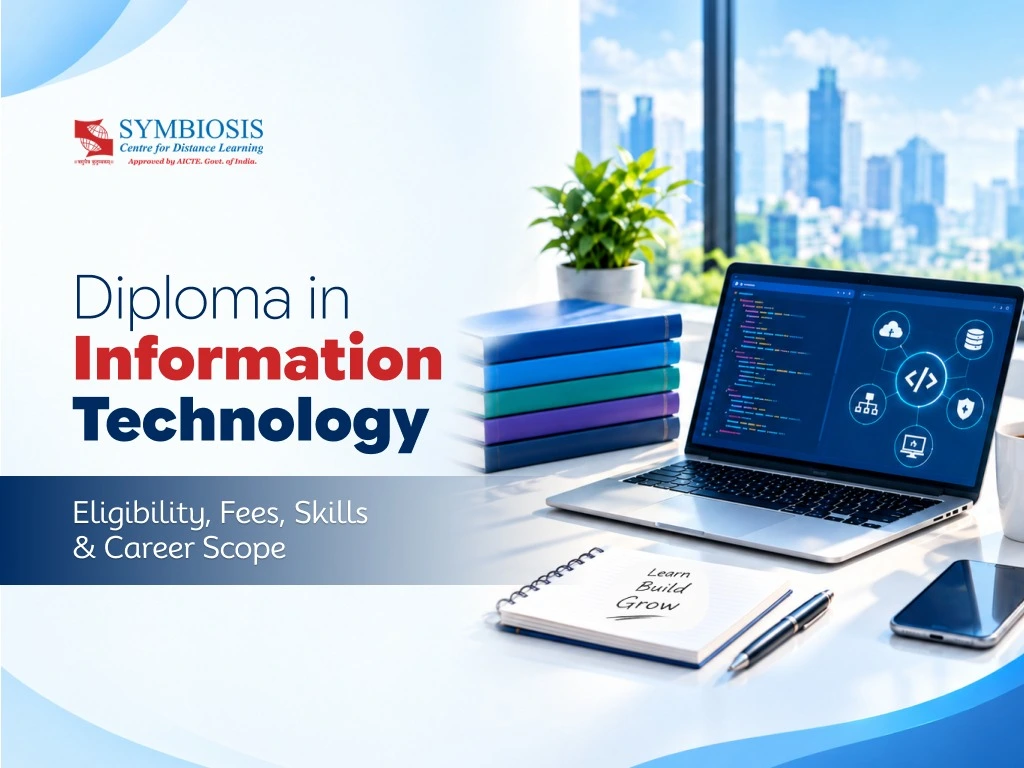

Technology has become part of almost every industry, creating demand for professionals who understand how digital systems, software, and data work. This has made IT courses a popular choice among students, graduates, and working professionals looking to enter the technology field or build new skills.
A Diploma in Information Technology helps learners build foundational knowledge across different areas such as coding, database management, software development, and cybersecurity. However, different IT diploma programmes cater to different learning goals, skill levels, and career aspirations. Some programmes are designed for students after Class 10 or 12, while a PG Diploma in Information Technology is aimed at graduates.
Choosing the right IT programme starts with understanding its eligibility, fees, duration, syllabus, and career scope. This guide covers the key aspects of an IT diploma and explores the PG Diploma in IT offered by Symbiosis Centre for Distance Learning (SCDL).
What Is a Diploma in IT?
A Diploma in Information Technology is a career-oriented programme that introduces learners to the technologies and systems used to store, process, manage and communicate information.
The curriculum may cover different topics such as:
- Computer fundamentals
- Programming
- Database management
- Web technologies
- Operating systems
- Computer networks
- Software engineering
- Information security
- Cloud computing
- Data analytics and emerging technologies
The exact course structure varies between institutions. For example, conventional IT diploma programmes may be three-year technical programmes after Class 10, while postgraduate programmes are intended for graduates and combine advanced IT concepts.
Diploma in IT vs PG Diploma in IT
Although both programmes focus on Information Technology, they are designed for different learners. An IT diploma is generally an entry-level qualification, while an PG Diploma in Information Technology is meant for graduates who want to build more advanced knowledge and skills in the field.
| Basis | Diploma in IT | PG Diploma in IT |
| Entry Requirement | Depending on the institute | Usually a bachelor’s degree |
| Level | Undergraduate/entry-level | Postgraduate |
| Focus | IT fundamentals and practical technical skills | Advanced IT concepts, applications and management |
| Typical Duration | Around 1–3 years | Usually 1–2 years |
| Suitable For | Students starting their IT education | Graduates and working professionals |
| Further Learning | Can be followed by a degree or advanced certification | Can complement a graduate degree and professional experience |
Diploma in IT Eligibility Criteria
The eligibility requirements for an IT diploma differ across institutions and programmes. Admission criteria depend on the course level and the institute offering the programme.
For a conventional IT diploma, Class 10 is a common entry point. Some institutions may require students to have studied subjects such as Mathematics and Science.
For a PG Diploma in Information Technology, a bachelor’s degree is generally required, although specific eligibility criteria vary by institution.
SCDL’s current eligibility criteria include:
- A bachelor’s degree in any field from a recognised university.
- International or SAARC graduates from a recognised/accredited institution
- Students awaiting their final-year bachelor’s results may also apply, subject to completing their graduation within the period specified by SCDL
Who Can Consider an IT diploma?
An IT diploma can suit different learners depending on the programme they choose.
It may be worth considering if you:
- Want to start learning technology after Class 10 or 12
- Want a focused qualification for entering the IT field
- Are a graduate looking to move towards technology-related roles
- Are a working professional considering a shift into IT or technology-enabled business roles
Diploma in IT Fees & Duration
The cost and duration of an IT diploma vary by institution, course level, and learning format. Diploma programmes pursued after Class 10 or 12 typically span 2–3 years, whereas postgraduate diplomas intended for graduates generally have a shorter duration.
Here is an overview of the duration and fees for SCDL’s PG Diploma in Information Technology:
| Particulars | SCDL PG Diploma in Information Technology |
| Programme Duration | 2 years |
| Registration Validity | 4 academic years |
| Total Programme Fee | INR 81,000 |
| Application Fee | INR 1,200 |
| First Instalment | INR 49,000 |
| Second Instalment | INR 32,000 |
| Exam & Project Fee | Additional |
Note: Fees are subject to change as per the applicable admission cycle. Exam and project fees are not included in the programme fee.
Diploma in IT Admission Process
The admission process may vary depending on the institution and programme. For SCDL, the current online admission process includes:
Step 1: Check eligibility
Confirm that your educational qualification matches the programme requirements.
Step 2: Choose the programme
Review the curriculum, duration, fees, and learning format.
Step 3: Complete the application
Register on the institution’s admission portal and fill in the application form.
Step 4: Submit documents
Upload or submit the required academic and identity documents.
Step 5: Pay the applicable fees
Complete the application process with the payment of applicable programme fee.
Note: Candidates should also check the current admission schedule because application windows and fee policies can change.
Diploma in IT Syllabus: What Will You Study?
The IT diploma syllabus may differ based on the institute, course structure, and level of study. In general, it covers areas such as programming, databases, software development, IT management, cybersecurity, cloud computing, and emerging technologies.
For graduates looking for a postgraduate qualification in IT, SCDL’s PG Diploma in Information Technology has an 80-credit curriculum spread across four semesters. The programme covers areas such as business analysis, project management, data science, AI, and cloud computing.
| Semester | Subjects |
| Semester I | Principles and Practices of Management; Business Communication; Information Technology Fundamentals; Database Management Systems; Algorithms and Programming Concepts |
| Semester II | Business Requirements Analysis; IT Project Management; Business Process Modelling; Software Engineering with UML; Software Testing and Agile Practices |
| Semester III | Software Quality Management; Introduction to Data Science, Machine Learning and AI; E-Business; Information Security Management; Software Documentation |
| Semester IV | Emerging Trends in IT; Business Applications and ERP; Cloud Computing; Project Work |
Skills You Can Develop Through an IT diploma
An IT qualification should ideally help you build skills that can be applied beyond the classroom.
- Programming and logical thinking: Programming introduces structured problem-solving and helps learners approach technical problems systematically.
- Database management: Understanding how information is stored, organised and accessed is useful across software, analytics, and business systems.
- Information security awareness: As organisations handle increasing amounts of digital information, understanding basic security principles is relevant across technology roles.
- Project and business understanding: Postgraduate IT programmes may also develop skills in requirements of analysis, project management, and business processes.
Career Scope After a Diploma in IT
A Diploma in Information Technology can prepare you for entry-level roles across software development, technical support, web development, networking and software testing.
| Job Role | Indicative Salary Range in India |
| Junior Web Developer | INR 2.8–5 LPA |
| Software Tester / QA Engineer | INR 2.8–5 LPA |
| Network Administrator / Technician | INR 3–6 LPA |
| Junior Software Developer | INR 3–6 LPA |
| Database Administrator | INR 3–6 LPA |
| Data Analyst | INR 3–6 LPA |
| Cybersecurity Analyst | INR 3.5–6.5 LPA |
| Business Analyst | INR 3.5–7 LPA |
| Cloud Support Engineer | INR 4–7 LPA |
Note: Salary ranges are indicative and may vary based on qualifications, skills, experience, location, and employer. An IT diploma does not guarantee a particular salary or job role.
Can an IT Diploma Help You Build a Career in Technology?
Yes, a Diploma in IT can be a good starting point for a career in technology, particularly for learners who want to develop practical technical skills without immediately pursuing a full degree. It can introduce you to areas such as programming, databases, web development, networking, software testing, and information security.
However, a diploma alone may not be enough for every technology role. Employers often look at technical skills, practical projects, certifications, and work experience along with the qualifications. Building skills in areas such as cloud computing, data analytics, cybersecurity, or AI can also help you move towards specialised roles.
For graduates, a PG Diploma in Information Technology can be a more suitable option when the goal is to gain postgraduate-level knowledge and build an existing bachelor’s degree.
How to Choose the Right IT diploma?
When selecting an IT diploma, you must evaluate these important factors:
- Eligibility and programme level: Choose a regular IT diploma if you are starting your IT education after Class 10 or 12. If you already have a bachelor’s degree, a PG Diploma in IT may be more relevant.
- Syllabus: Look for subjects that match your interests and career goals, such as programming, databases, software development, networking, cybersecurity, cloud computing, or data analytics.
- Fees, duration and learning mode: Check the complete fee structure, programme duration and whether the course is offered online, through distance learning or in a classroom format.
- Recognition and practical exposure: Verify the institution’s applicable approvals or recognition and look for programmes that include projects, assignments or other opportunities to apply what you learn.
Ultimately, the best choice is not necessarily the programme with the lowest fee or shortest duration. The curriculum, credibility, practical learning, and relevance to your career goals should carry more weight in your decision.
Why Consider SCDL for a PG Diploma in IT?
For graduates looking for a postgraduate qualification in IT, SCDL’s PG Diploma in Information Technology is an option worth considering.
The programme combines technical concepts with business and IT management skills, making it relevant for learners interested in both technology and its application in organisations.
Some key aspects of the programme include:
- A two-year postgraduate programme with a registration validity of four academic years.
- An AICTE-approved programme, as stated on SCDL’s official programme page.
- Assessment through assignments and computer-based examinations, with each course carrying 30 marks for the assignment and 70 marks for the examination.
- A 100-mark online project in the fourth semester, giving learners an opportunity to apply their learning to a practical project.
- Access to digital learning resources, lectures, study material, assignments, faculty interaction, e-mentoring and student support through SCDL’s learning platform.
- A flexible structure that can be considered by working professionals who want to pursue a postgraduate IT qualification alongside their existing responsibilities.
FAQs
1. What is a Diploma in IT?
A Diploma in IT is a career-focused programme that introduces learners to areas such as programming, databases, networking, software development, information security, and other core IT concepts. The level and curriculum can vary depending on the institution and whether it is a regular diploma or a postgraduate diploma.
2. Can I do an IT diploma after Class 12?
Yes, many IT diploma programmes accept students after Class 12, although eligibility requirements vary by institution. Some technical diploma programmes may also accept students after Class 10. Students should check the specific programme’s eligibility criteria before applying.
3. Can I pursue a PG Diploma in IT after graduation?
Yes, a PG Diploma in IT is designed for graduates who want to develop advanced knowledge of Information Technology. Some programmes accept graduates from different academic backgrounds, while others may have specific subject or qualification requirements.
4. What are the career options after a Diploma in IT?
Depending on their skills, qualification level and experience, Diploma in IT graduates can explore roles such as IT Support Executive, Junior Software Developer, Web Developer, Software Tester, Network Technician and Database Support professional.
5. Is a Diploma in IT enough to get a job?
A Diploma in IT can help you qualify for entry-level technology roles, but employment also depends on your technical skills, practical experience, projects, and the requirements of individual employers. Building skills in areas such as programming, databases, cloud computing or cybersecurity can improve your career opportunities.
6. Is a Diploma in IT good for working professionals?
Yes, particularly when the programme is offered in an online or distance-learning format. Working professionals can use such programmes to build IT knowledge while continuing their jobs. However, the programme’s schedule, learning format, duration, and assessment requirements should be checked before enrolling.



 Symbiosis Online