
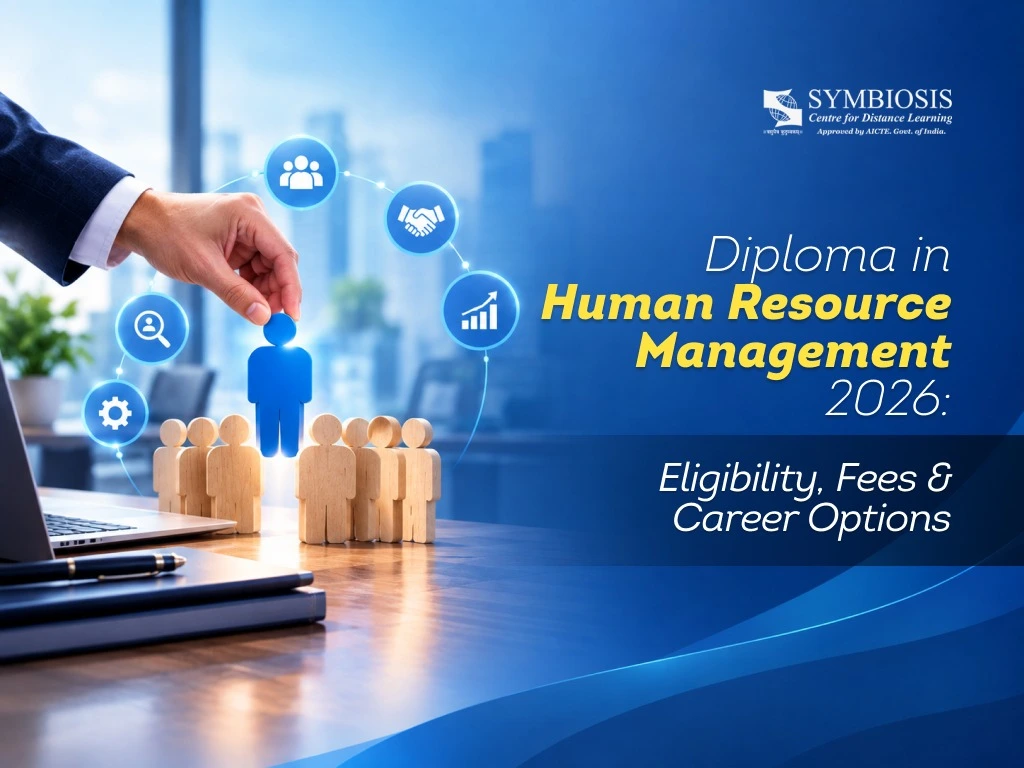

Hiring and interviews are often seen as the core of HR, but the function extends well beyond recruitment. HR professionals are involved in employee onboarding, performance management, learning and development, compensation, workplace policies, and employee relations.
For those planning a career in HR, a Diploma in Human Resource Management can provide a practical foundation without requiring a full MBA. However, the ideal programme depends on your education and career goals. A diploma after Class 12 can have different eligibility criteria, curriculum, duration, and outcomes compared with a postgraduate diploma for graduates.
Graduates and working professionals seeking deeper expertise can explore options such as SCDL’s Post Graduate Diploma in Human Resource Management, covering areas such as performance management, compensation, employee relations, labour laws, and human resource development.
This guide covers what you need to know before choosing a Diploma in HRM, including eligibility, fees, duration, syllabus, admission process, and career options.
What Is a Diploma in HRM?
A Diploma in Human Resource Management is a career-focused course that introduces learners to essential HR concepts and people-management practices. It helps students understand how HR teams manage employees and contribute to the broader goals of an organisation.
Depending on the level and structure of the programme, subjects may include recruitment and selection, employee relations, performance management, training and development, compensation, organisational behaviour, and labour laws.
Those who already hold a bachelor’s degree and want to deepen their HR knowledge can explore postgraduate programmes. One such option is SCDL’s Post Graduate Diploma in Human Resource Management, which provides broader and more specialised learning across HR and related management functions.
Diploma in HRM vs PG Diploma in HRM
A Diploma in HRM and a Post Graduate Diploma in HRM are different qualifications, mainly in terms of entry requirements and level of study.
| Factor | Diploma in HRM | PG Diploma in HRM |
| Entry level | Usually suitable after Class 12 | Usually requires graduation |
| Level of study | Diploma | Postgraduate |
| Course focus | Builds basic understanding of HR | Covers HR functions in greater depth |
| Suitable for | Students starting out or exploring HR | Graduates and working professionals |
| Career relevance | Useful for building an HR foundation | Suitable for graduates seeking more advanced HR knowledge |
A diploma can make sense if you are starting out and want to get familiar with HR before taking up a longer qualification. A PG diploma, on the other hand, is generally a better fit if you already have a bachelor’s degree and want to study HR at a higher level.
Who Should Consider a Diploma in HRM?
An HR qualification can benefit learners at various stages of their academic and professional journey.
It may be worth considering if you are:
- A Class 12 student interested in entering HR
- A graduate looking for specialised HR knowledge
- A working professional handling people-related responsibility
- An HR professional looking to strengthen formal knowledge
- A professional planning a career switch into HR
For working professionals, flexible learning can also be a deciding factor. SCDL’s PGDHRM, for example, has a two-year programme duration and four academic years of registration validity.
Diploma in HRM Eligibility
Eligibility criteria for a Diploma in HRM can differ based on the institute and programme level. However, applicants generally need to meet the following requirements:
- Diploma in HRM: Usually Class 12 or equivalent from a recognised board
- PG Diploma in HRM: A recognised university bachelor’s degree
- Work experience: Usually not compulsory, although some programmes may have their own requirements
- Final-year students: Some institutes allow students to await graduation results to apply provisionally, subject to their admission requirements.
For example, SCDL’s PGDHRM is open to graduates from any discipline from a recognised university, subject to its admission requirements. Those pursuing the final year of a bachelor’s programme may be eligible for provisional admission.
Diploma in HRM Fees & Duration in 2026
The cost of an HRM programme can vary depending on the institute and the level of the course. A regular diploma may be shorter, while a PG programme generally takes longer and covers HR in greater depth.
For students planning to pursue HRM through SCDL, the Post Graduate Diploma in Human Resource Management has a duration of two years. The applicable fee for general-category learners is as follows:
| SCDL PGDHRM Fee Component | Amount |
| Programme Fee | INR 81,000 |
| 1st Instalment | INR 49,000 |
| 2nd Instalment | INR 32,000 |
| Application Fee | INR 1,200 |
| Duration | 2 years |
| Registration Validity | 4 academic years |
The INR 81,000 programme fee does not include examination and project charges. Printed self-learning material is also available as an optional paid service.
Diploma in HRM Syllabus and Subjects
The subjects covered can vary across HRM programmes. If you are considering SCDL, the PGDHRM follows a four-semester structure, with subjects becoming more specialised as the programme progresses.
| Semester | Key Subjects Covered |
| Semester 1 | Fundamentals of Human Resource Management, Human Resource Development, Industrial & Labour Economics, Leadership and Personality Development |
| Semester 2 | Performance and Potential Management, Labour Welfare and Workplace Safety, Compensation Management, Labour Laws – I |
| Semester 3 | Employee Relations, Organisational Development, Human Resource Information Systems (HRIS), Labour Laws – II |
| Semester 4 | Total Quality Management and HR Audit, Research Methodology and Statistical Methods, Project Work |
The final semester also includes a project, giving learners an opportunity to apply what they have studied to an HR-related area.
What Skills Can You Develop with an HRM Diploma?
An HR qualification is not only about learning HR concepts. It can also help you build skills that are useful when dealing with employees, managers, and everyday workplace situations.
Some of the key skills you may develop include:
- Recruitment and hiring: Understanding how organisations identify, screen and select candidates.
- Employee relations: Learning how to communicate with employees and handle common workplace concerns.
- Performance management: Understanding how employee performance is assessed, reviewed, and improved.
- Communication: Building clearer communication skills for interviews, meetings, employee interactions, and workplace discussions.
- HR documentation: Becoming familiar with maintaining employee records, HR processes, and workplace documentation.
- Understanding labour laws: Developing basic awareness of the laws and regulations that affect employees and employers.
Admission Process for an HR Management Diploma
The admission process for a Diploma in HRM includes the following steps:
Step 1: Check Eligibility
Review the academic requirements for the programme.
Step 2: Choose the Programme
Compare the curriculum, duration, learning format, fees and admission requirements.
Step 3: Apply Online
Fill in the application form with your personal and academic details.
Step 4: Submit Documents
Upload the required academic certificates, identity proof, and other documents.
Step 5: Complete Admission Formalities
Complete document verification and pay the applicable fee to complete your enrolment.
For SCDL’s PGDHRM, applicants can apply through the online admission portal and submit the required academic documents. Candidates awaiting their graduation results may also be eligible for provisional admission, subject to SCDL’s requirements.
Learning Experience
The learning experience can vary depending on the institute and mode of delivery. If you are considering an online HRM programme, look for a course that gives you flexibility without compromising academic support.
Some aspects of the learning experience may include:
- Flexible learning: Study at your own pace and manage your coursework alongside work, college or other commitments.
- Self-learning resources: Access to study material and digital resources to support your learning and assessment preparation.
- Assignments: Complete assignments that help you understand and apply concepts covered during the programme.
- Practical project: A final project can give you an opportunity to explore an HR-related topic and apply what you have learned. The final project can give you an opportunity to explore an HR-related topic and apply what you have learned. final project can give you an opportunity to explore an HR-related topic and apply what you have learned.
For example, SCDL’s PGDHRM follows a self-learning format and includes assignments, computer-based examinations, and a project. Its four-semester structure covers areas such as employee relations, organisational development, HR information systems, and HR audits.
Career Options After a Diploma in HRM
An HRM qualification can prepare you for entry-level and junior roles across recruitment, HR operations, employee relations, payroll and training.
Some career options after a Diploma in HRM or a related postgraduate qualification include:
| Career Option | Typical Work | Indicative Salary Range in India |
| HR Executive | Recruitment support, onboarding, employee records and routine HR activities | INR 2.5–5 LPA |
| HR Coordinator | Interview scheduling, documentation, employee communication and HR coordination | INR 2.5–5 LPA |
| Recruitment Executive | Candidate sourcing, screening, interview coordination and hiring support | INR 2.5–5.5 LPA |
| Talent Acquisition Executive | Managing candidate pipelines and supporting end-to-end hiring | INR 3–7 LPA |
| Payroll Executive | Attendance, salary processing, payroll records and related documentation | INR 3–6 LPA |
| Training Coordinator | Coordinating training programmes, schedules and employee learning records | INR 3–6 LPA |
| HR Generalist | Supporting recruitment, employee relations, HR operations and other HR functions | INR 4–8 LPA |
| Employee Relations Executive | Handling employee communication, workplace concerns and related HR processes | INR 3–6 LPA |
Note: Salary figures are indicative annual ranges in India and can vary based on experience, location, industry, organisation and skill set.
Diploma in HRM vs MBA in HR
A diploma or PG diploma and an MBA in HR can both support an HR career, but they are different qualifications.
| Factor | Diploma/PG Diploma in HRM | MBA in HR |
| Programme focus | HR-focused | Management + HR specialisation |
| Duration | Usually shorter | Around 2 years |
| Cost | Often lower | Usually higher |
| Academic scope | Focused HR learning | Broader business and management education |
| Suitable for | Focused HR knowledge or career transition | Broader management and leadership preparation |
| Career objective | HR functional roles | HR and broader management roles |
A diploma or PG diploma may suit learners looking for focused HR knowledge, while an MBA can be more appropriate for those seeking broader management education. The right choice depends on your qualifications, experience, budget, and career goals.
Is a Diploma in HRM Worth It in 2026?
A Diploma in HRM can be a useful starting point if you want to enter the HR field, switch careers, or build formal knowledge alongside your existing job. It can introduce you to areas such as recruitment, employee relations, performance management, and compensation.
However, the qualification alone does not guarantee career growth. Your practical skills, work experience, communication abilities, and knowledge of HR tools also matter. For graduates looking for deeper HR knowledge, a postgraduate programme such as SCDL’s PGDHRM can be a more suitable option.
Overall, a Diploma in HRM is worth considering when the course level, curriculum, learning format, and career goals align with what you want to achieve.
What to Check Before Choosing an HRM Diploma?
Before enrolling in an HRM diploma, compare what the programme offers rather than looking at the course name alone. A few things worth checking are:
- Eligibility: Make sure you meet the academic requirements, especially if you are considering a postgraduate diploma.
- Curriculum: Check whether the programme covers important areas such as recruitment, performance management, compensation, employee relations and labour laws.
- Duration and fee: Compare the total programme cost, duration and any additional charges such as examination or project fees.
- Assessment pattern: Look at how assignments, examinations, and projects contribute to the final evaluation.
- Recognition and credibility: Verify the institute’s current approvals, recognition, and programme status before applying.
- Learning support: Check out what study material, digital resources, academic support, and other learning facilities are available.
Conclusion
A Diploma in HRM can be a practical starting point for building knowledge in recruitment, employee relations, performance management, and other core HR functions. The right programme depends on your academic background and career goals.
While a diploma may suit beginners; graduates and working professionals can consider a PG Diploma such as SCDL’s PGDHRM for more specialised learning. Before enrolling, students should compare the curriculum, fees, duration, recognition, and learning format to choose a programme that supports their career plans.
FAQs
1. What is a Diploma in HRM?
A Diploma in HRM is a career-focused programme that introduces learners to key areas of human resource management, such as recruitment, employee relations, performance management, compensation and labour laws. It can be suitable for students and professionals who want to build foundational HR knowledge.
2. What is the eligibility for a Diploma in HRM?
Eligibility varies by institute and programme level. A regular Diploma in HRM may require Class 12 or an equivalent qualification, while a PG Diploma in HRM generally requires a bachelor’s degree. For example, SCDL’s PGDHRM accepts graduates from any discipline, subject to its admission requirements.
3. How much does a Diploma in HRM cost?
The fee depends on the institute, programme level, and mode of learning. Additional charges may also apply for examinations, projects, or study materials. For reference, SCDL’s PGDHRM has a current programme fee of INR 81,000, along with an INR 1,200 application fee; examination and project charges are separate.
4. What are the career options after a Diploma in HRM?
After completing a Diploma in HRM, you can explore entry-level roles such as HR Executive, HR Coordinator, Recruitment Executive, Talent Acquisition Executive, Payroll Executive and Training Coordinator. With relevant experience and additional qualifications, you can progress towards more senior HR roles.
5. Is a Diploma in HRM better than a PG Diploma in HRM?
It depends on your qualifications and what you want to do next. A Diploma in HRM is generally suitable for learners starting out after Class 12, while a PG Diploma in HRM is meant for graduates and covers HR and management in greater depth.


 Symbiosis Online