
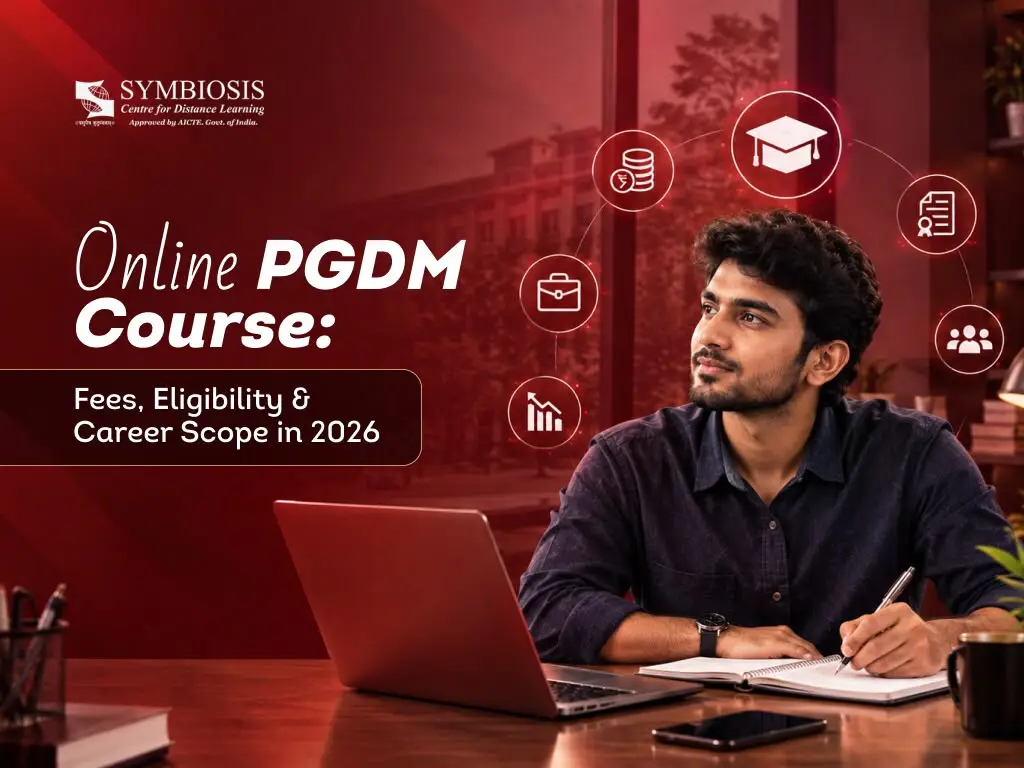

An online PGDM course is a flexible management programme designed for learners who want to build business and management skills without attending conventional classroom programmes. Depending on the institute, an online PGDM may cover areas such as finance, marketing, human resources, operations, business analytics, and strategic management.
The course format can be particularly relevant for working professionals who want to study alongside their jobs. However, online PGDM programmes differ in terms of qualification awarded, eligibility, duration, fees, curriculum, and regulatory status. Therefore, students should check the exact programme details before applying.
For learners specifically looking at flexible management programmes for working professionals, the Symbiosis Centre for Distance Learning (SCDL) offers an Executive PGDM designed for candidates with prior work experience. Its current programme is 15 months long and has specific eligibility and fee requirements.
What Is an Online PGDM Course?
An online PGDM course is a postgraduate-level management programme delivered through an online learning format.
The curriculum generally focuses on practical areas of business and management, although the subjects and specialisations vary by institution.
An online PGDM may include subjects such as:
- Business communication
- Management principles
- Marketing management
- Financial management
- Human resource management
- Operations management
- Business analytics
- Strategic management
- Project management
- Digital transformation
Why Consider an Online PGDM?
An online PGDM can be useful for learners who want management education with greater flexibility than a conventional full-time programme.
- Flexible learning: Online programmes allow learners to access course content and complete academic activities through digital platforms. This can make them suitable for people managing work or other commitments.
- Management-focused curriculum: PGDM programmes focus on business functions and managerial skills. Depending on the programme, students may study areas such as marketing, finance, HR, operations, analytics, and strategy.
- Opportunity to upskill while working: Working professionals can use the programme to strengthen their existing business knowledge without necessarily taking a career break.
- Specialisation options: Depending on the institution, learners may be able to focus on a particular management area. This can help align the programme with their existing role or intended career path.
Online PGDM Eligibility Criteria
The eligibility requirements for an online PGDM course depend on the institute and the programme you choose. In most cases, candidates need a bachelor’s degree from a recognized university. Some programmes may also have a minimum marks requirement, while executive PGDM programmes may ask for relevant work experience.
Before applying, it is worth checking the following:
- Educational qualification: A bachelor’s degree or equivalent qualification from a recognized university is generally required.
- Minimum marks: Some institutes may specify a minimum percentage or CGPA at graduation.
- Work experience: This is mainly relevant for executive PGDM programmes, which are designed for working professionals.
- Entrance requirements: While some programmes offer admission based on eligibility, others may have an entrance test or additional selection criteria.
- Other requirements: Candidates with international qualifications may need to meet additional recognition or equivalence requirements.
The criteria can be quite different for an executive programme. For example, Symbiosis Centre for Distance Learning (SCDL) requires candidates for its Executive PGDM to have a bachelor’s degree with at least 50% marks and a minimum of five years of work experience at management or supervisory levels.
Online PGDM Course Fees & Duration
The fees and duration of an online PGDM course vary by institute and programme. Executive programmes may follow a shorter or different schedule.
For instance, the SCDL Executive PGDM is a 15-month programme with a fee of INR 95,000. The programme fee does not include applicable examination and project-related charges.
| Particular | SCDL Executive PGDM |
| Duration | 15 months |
| Programme fee | INR 95,000 |
| Application fee | INR 1,200 |
| Payment option | Two instalments; EMI options available |
| Exam & project fee | Additional |
Note: The fee and admission conditions can change for a new admission cycle, so students should check the latest official fee details before applying.
Online PGDM Specialisations
An online PGDM allows students to specialize in a particular area of management after learning the basics of business and management. The available options differ across institutes, but some commonly offered specialisations include:
| Specialisation | Focus Areas |
| Finance | Financial planning, investment, risk management and corporate finance |
| Marketing | Customer engagement, market trends, promotional strategies and brand development |
| Human Resource | Talent management, recruitment, employee development and organisational behaviour |
| Operations | Process management, productivity, quality and operations planning |
| Business Analytics | Interpreting business data, identifying trends and supporting organisational planning |
| Supply Chain Management | Procurement, logistics, inventory control and supply chain management |
SCDL’s Executive PGDM currently offers specialisations in Finance, Marketing, Human Resource, Operations and Supply Chain Management. The available specialisations can vary across programmes, so students should check the latest programme structure before applying.
Online PGDM Course Curriculum
An online PGDM curriculum usually covers core management concepts along with subjects related to the chosen specialisation. The exact syllabus varies by institute and programme.
For instance, the SCDL Executive PGDM follows a three-semester structure covering management fundamentals, specialised subjects, and a project.
| Semester | Key Subjects |
| Semester I | Corporate Communication and Managerial Effectiveness, Legal Aspects of Business, Big Ideas with Design Thinking, Business Analytics for Competitive Advantage, Leadership, Values & Business Ethics |
| Semester II | Data Visualization and Decision Making, Project Management, plus subjects related to the chosen specialisation |
| Semester III | Business and Corporate Strategy, Managing Digital Transformations, Research Methodology and Project |
How to Apply for an Online PGDM?
Applying for an online PGDM involves checking the programme requirements, completing the online application, submitting the required documents, and paying the applicable fees. The exact admission process varies by institute.
Step 1: Check programme eligibility
Review the required educational qualifications, minimum marks, and work experience, if applicable.
Step 2: Choose the programme and specialisation
Compare the available specialisations, curriculum, duration and fee structure before selecting a programme.
Step 3: Complete the online application
Fill in the required personal, academic, and professional details through the institute’s admission portal.
Step 4: Submit the required documents
Upload the academic records, identity proof, and other documents specified by the institute.
Step 5: Pay the applicable fee
Complete the application or programme fee payment through the prescribed payment method.
Step 6: Complete verification and enrolment
The institute verifies the submitted information and documents before confirming admission and providing access to the programme.
Note: For SCDL’s Executive PGDM, applicants must follow the institute’s prescribed application, registration, document submission, and fee-payment requirements.
How Does an Online PGDM Work?
An online PGDM follows a structured learning format where students complete their coursework through digital platforms instead of attending regular classroom sessions. The learning experience includes:
- Online classes: Attend live or recorded lectures through the institute’s learning platform.
- Digital study material: Access course content, presentations, videos, and other learning resources online.
- Assignments and assessments: Complete assignments, quizzes, case studies, or other assessments as part of the programme.
- Examinations: Appear for examinations according to the institute’s prescribed schedule and format.
- Projects: Some programmes include practical projects that help learners apply management concepts to real business situations.
- Academic support: Students can access faculty or learner support services for academic queries and programme-related assistance.
The exact class schedule, assessment pattern, examination method, and learning resources depend on the institute. For working professionals, this format can make it easier to continue learning alongside existing work commitments.
Career Scope After an Online PGDM
An online PGDM can help learners build management skills and prepares across areas such as marketing, finance, human resources, operations, business development and supply chain management.
| Job Role | Indicative Salary Range |
| Business Development Executive/Manager | INR 3–10 LPA |
| Marketing Executive/Manager | INR 3–12 LPA |
| Financial Analyst | INR 4–10 LPA |
| HR Executive/Manager | INR 3–10 LPA |
| Operations Executive/Manager | INR 3–10 LPA |
| Supply Chain Analyst/Manager | INR 4–12 LPA |
| Project Manager | INR 5–15 LPA |
| Business Analyst | INR 4–12 LPA |
Note: Salary ranges are indicative and can vary significantly based on experience, location, skills, specialisation, company and job role.
For experienced professionals, an online PGDM can also support career progression into managerial and leadership roles by strengthening their existing business and functional expertise.
Online PGDM vs Online MBA
Online PGDM and online MBA both focus on management education, but the two qualifications differ mainly in the type of qualification awarded and programme structure.
| Factor | Online PGDM | Online MBA |
| Qualification | Postgraduate Diploma in Management | Master of Business Administration |
| Focus | Varies by institute and programme | Varies by institute and programme |
| Curriculum | May offer greater focus on current industry practices and specialised areas | Usually follows a structured management curriculum with core and elective subjects |
| Duration | Commonly 1–2 years, depending on the programme | Usually around 2 years |
| Eligibility | Requires a bachelor’s degree; some programmes may have additional requirements | Requires a bachelor’s degree; requirements vary by university |
| Specialisations | Finance, Marketing, HR, Operations, Analytics, etc. | Finance, Marketing, HR, Operations, Analytics, etc. |
An online MBA awards a master’s degree, while an online PGDM awards a postgraduate diploma. Before enrolling, students must check the institute’s recognition, programme structure, eligibility, and the qualification awarded.
Things to Check Before Choosing an Online PGDM
Before enrolling in an online PGDM, consider these factors to make sure the programme fits your academic and career goals:
- Recognition and validity: Check the institute’s recognition and the regulatory status of the programme.
- Eligibility criteria: Review the required degree, minimum marks and work experience, if applicable.
- Curriculum and specialisation: Check whether the subjects and specialisations match your career interests and skill requirements.
- Total programme fee: Look at the complete cost, including application, examination, project or other additional charges.
- Learning format: Understand how live classes, recorded lectures, study material, and learner support are provided.
- Examination pattern: Check out the assessment method, examination schedule, and project requirements.
- Academic support: Look for details about faculty interaction, doubt resolution, and student support.
- Career support: If placement or career assistance is offered, check out what it includes rather than assuming a job is guaranteed.
- Programme suitability: Consider whether the course is designed for fresh graduates, working professionals, or experienced managers.
Is an Online PGDM Valid?
Yes, an online PGDM can be a valid postgraduate management qualification, but its recognition depends on the institution, programme, mode of delivery, and applicable regulatory approvals.
Students should verify the programme’s current recognition and approval status before admission. For example, SCDL’s Executive PGDM is currently approved by AICTE.
FAQs
1. What is an online PGDM course?
An online PGDM course is a postgraduate diploma programme in management delivered through an online learning format. It generally covers areas such as finance, marketing, human resources, operations, business analytics, and strategic management, depending on the institute.
2. What is the eligibility for an online PGDM course?
Eligibility varies by institute. Generally, candidates need a bachelor’s degree from a recognized university, while some programmes may specify minimum marks or work experience. For example, SCDL’s Executive PGDM requires a bachelor’s degree with at least 50% marks and a minimum of five years of work experience at management or supervisory levels.
3. How much does an online PGDM course cost?
The fees vary depending on the institute, programme and specialisation. Additional charges may also apply for application, examinations,, or projects. For example, SCDL’s Executive PGDM has a programme fee of INR 95,000, excluding applicable examination and project-related charges.
4. How long is an online PGDM course?
The duration depends on the institute and programme structure. Some online PGDM programmes may be completed in around one year or more, while executive programmes can have a different duration. SCDL’s Executive PGDM, for instance, is a 15-month programme.
5. What are the career options after an online PGDM?
After completing an online PGDM, graduates may explore roles in areas such as marketing, finance, human resources, operations, business development, project management, business analytics and supply chain management. Career opportunities depend on the learner’s specialisation, skills, prior experience, and the organisation.



 Symbiosis Online